
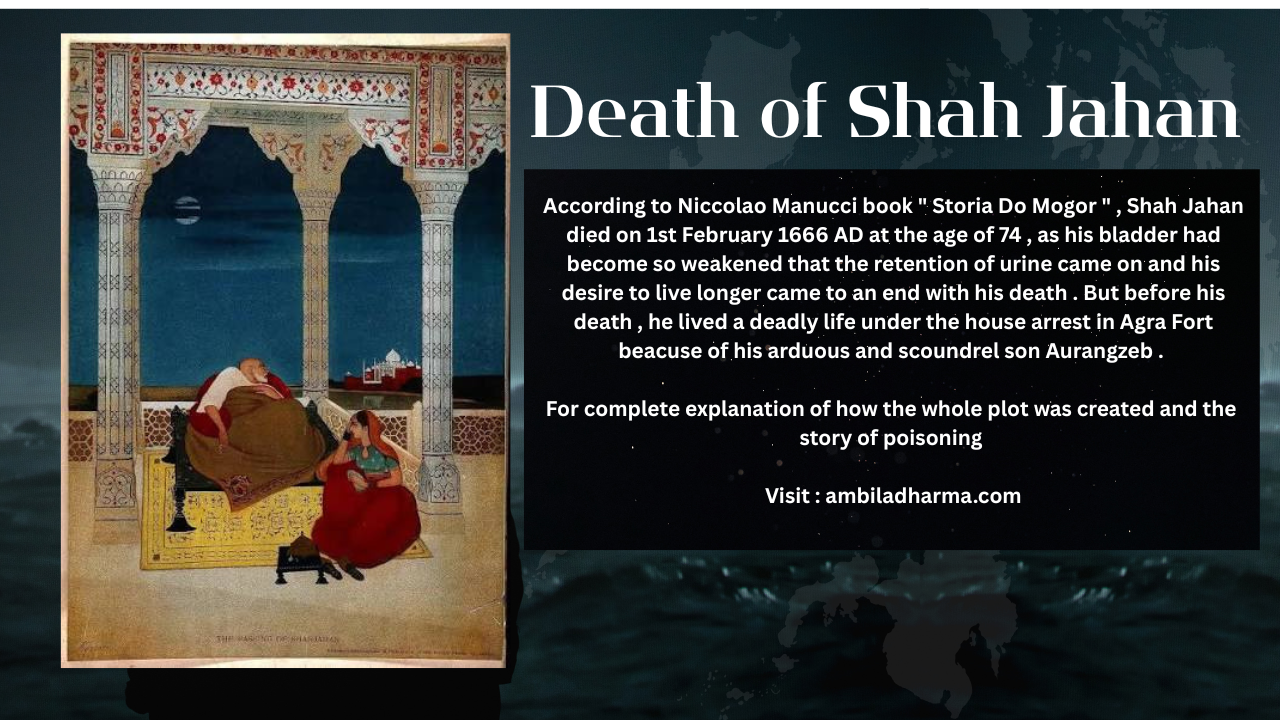
According to Niccolao Manucci book ” Storia Do Mogor ” , Shah Jahan died on 1st February 1666 AD because at the age of 74 , his bladder had become so weakened that the retention of urine came on and there was no medicine at that age which had the power to cure it . Meanwhile , a thought suddenly came to his mind about what Faqir had told him when he was Prince Khurram and was living in the Bijapuri territory . The Faqir had told him that ” when his death approached he would lose the smell of apples in his hands . Recognising what he said had now come true , his heart lost the desire of living longer and died .
While some text tells that he had died on 22 January 1666 .
Explanation
Shah Jahan was the fifth emperor of the Mughal Dynasty who ruled from 1628 to 1658 AD . Shah Jahan had various sons but among them the most popular ones were the names of Dara Shikoh and Aurangzeb and somewhat Murad Baksh . Among them , Aurangzeb, by his notorious and deadly conspiracy , turned himself into a victorious king who ruled the Mughal Empire after Shah Jahan . He not just killed all his bloodline brothers but also captured his own father Shah Jahan and made him live the rest of his life in Agra Fort as a prisoner .
He not just stopped there but went one step ahead and left no stone unturned in torturing and ill-treating his own father , even attempting multiple times to poison him . The story of traumatising and tormenting shah Jahan soon started after his capture .
His maltreating activity for his father took a more fatal and death dealing shape after following a recovery from a near-fatal bout of delirium from 22May to nearly for two months . Aurangzeb’s physicians advised him to seek respite in the serene valleys of Kashmir to restore his health. While Aurangzeb longed for the escape, he was paralyzed by fear from the mere thought of his father being alive and potentially reclaiming influence if not suppressed him .
Determined to find peace in Kashmir without the shadow of his father looming over him, Aurangzeb decided that Shah Jahan had to be removed—if not by the sword, then by breaking his spirit.
Psychological Warfare at Agra Fort
Aurangzeb initiated a campaign of severe mental torture, intending to force Shah Jahan to abandon the very will to live. His cruelty manifested in several calculated ways:
- Isolation: He ordered that the windows of the fort facing the river—where the elderly Shah Jahan used to sit for solace and recreation—be bricked up.
- Constant Terror: A unit of musketeers was stationed beneath the palace walls with orders to fire their weapons at intervals to disturb the peace of the aged Emperor. They were reportedly given instructions to shoot if Shah Jahan was even sighted at a window.
- Systematic Deprivation: To deepen his father’s despair, Aurangzeb removed the vast majority of the gold and silver coinage from the vicinity, ensuring that the process was as loud and disruptive as possible so that Shah Jahan would be forced to hear the literal stripping away of his legacy.
Reataliation of Shah Jahan
Shah Jahan who was thoroughly understanding these tactics of Aurangzeb which were designed to shatter him emotionally, displayed remarkable shrewdness. He maintained a facade of indifference, acting as though the harassment did not affect him. As a defiant counter-response to Aurangzeb’s gloom, Shah Jahan immersed himself in music, dance, and the company of the ladies of the Fort , using these “distractions” as a shield against his son’s psychological intimidation .
Aurangzeb Conspiracy
The eunuch of the fort, Itbar Khan, had been given the task to have a vigilant eye on Shah Jahan. He meticulously reported the Emperor’s every move to Aurangzeb. Shah Jahan’s denial of surrendering his emotion and sentiment under the feet of Aurangzeb made him go more arduous against his father . Ultimately, filled with a desire to clear his path, Aurangzeb hatched a sinister plot to assassinate his father with poison.To execute this conspiracy , he chose Mukarram Khan, Shah Jahan’s personal physician. Ironically, Mukarram Khan was the same man who had openly protested Aurangzeb’s arrival in Agra and the subsequent imprisonment of the old Emperor , Shah Jahan . Aurangzeb, confident in his plot , sent a vial of poison along with a letter that issued a chilling ultimatum:
“If you wish to live in peace, you must administer this medicine to Shah Jahan. Should you fail to obey, you shall pay with your own life.”
Mukarram Khan went into a profound moral crisis. He reminisced about the years of kindness Shah Jahan had bestowed upon him—how the Emperor had elevated him from obscurity to a life of immense dignity and luxury. Realizing that Aurangzeb would likely execute him regardless of the outcome to bury the secret, Mukarram Khan made a fateful choice. Preferring a death of honor over a life of treachery, he drank the poison himself and embraced death, staying loyal to his patron to the very end.
Aurangzeb, who had been anticipating news of his father’s demise, was filled with bitter disappointment and fury upon learning of the physician’s suicide.
While summer was knocking at the door , Aurangzeb was compelled to leave Delhi for the cooler climate of Kashmir for his better health. Before departing, he charged the eunuch Itbar Khan with a singular mission: to escalate the mental torture of Shah Jahan to such a degree that the old man’s heart would simply give out. Despite the relentless psychological assault, Shah Jahan—though physically frail—remained mentally sharp. He recognized these tactics for exactly what they were: a desperate attempt to induce a fatal shock.
Reconcillation Approach
Upon returning to Delhi with restored health, Aurangzeb made another attempt on his father’s life by hiring a European physician who was known to Shah Jahan as he had earlier been in charge of Shah Jahan health . However, Shah Jahan, sensing his son’s murderous intent, refused all medical treatment from this physician .
As rumors of Aurangzeb’s clandestine assassination plots began to circulate among the public, the fear of a popular uprising gripped the new Emperor. In a calculated move to salvage his reputation, he penned a deceptive letter to his father, seeking forgiveness and extending a hand of friendship . Shah Jahan who was aware of all mischievous act of his son , responded in a very kind but resilient manner
“I may forgive your other transgressions, but the barbarity you displayed by sending me the severed head of my beloved son, Dara Shikoh, is beyond the reach of mercy.”
Undeterred, Aurangzeb continued his charade, sending lavish gifts of jewelry to the fort to create the public illusion that he had been redeemed in his father’s eyes.
Death Confirmation
The moment Aurangzeb had long awaited finally arrived on February 1, 1666, when Shah Jahan took his final breath. Even in death, Aurangzeb’s paranoia lingered. Suspecting how Shah Jahan, when known as Prince Khurram, pretended his death to gain the throne , the same manner he might have sought a similar method for getting out of prison and reclaiming the throne of Mughal Emperor . So, to ensure his father was not merely feigning his death, he sent a trusted aide to press a red-hot iron rod against the deceased Emperor’s feet. When this failed to provide absolute certainty, he went to the gruesome length of ordering a deep incision from the head to the neck.
Only after this horrific confirmation, Aurangzeb felt a sense of profound relief. Deep within, he rejoiced; his greatest rival, his own father, was finally removed from his path forever.
12 thoughts on “How Did Shah Jahan Die | Death and Conspiracy”
Comments are closed.